
Winter towing checklist for northern Alberta highways
A sourced, step-by-step checklist for towing a trailer, sled deck or camper in winter: tires, hitch and chains, trailer brakes, lights, following distance, sway and hills.
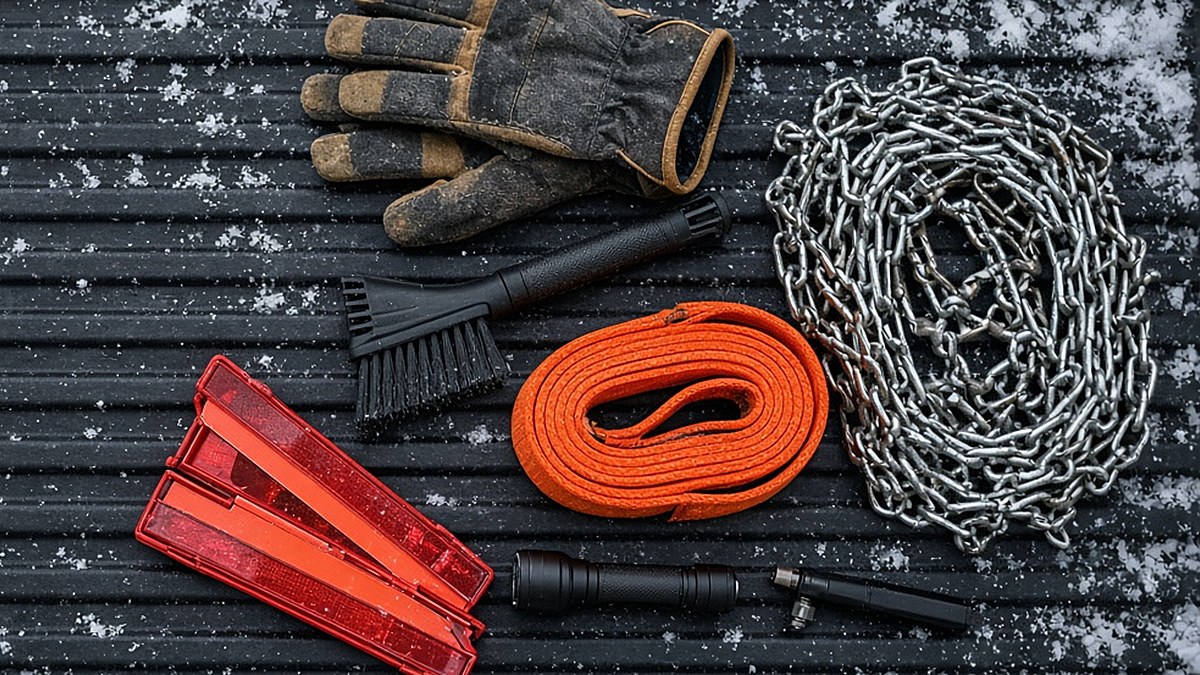
The short version
- Check 511 Alberta before you leave. Conditions on long northern stretches can change between towns.
- Below about 7°C, all-season and summer tires lose traction (Transport Canada). Fit winter tires on all four wheels of the truck.
- Alberta requires two separate means of attachment (except fifth wheels). Cross the safety chains under the tongue and don't let them drag.
- Leave at least one truck-and-trailer length per 16 km/h, and more on snow and ice.
- If the trailer sways, ease off the throttle and hold the wheel steady. Don't steer out of it or brake hard.
Long distances between towns, early dark, blowing snow and frost-heaved pavement make winter towing in northern Alberta its own job. Work through this checklist before you hook up, at every fuel stop, and again before any big hill.
1. Before you leave: plan the drive
- Check 511 Alberta for road conditions, closures and cameras along your whole route, not just near home.
- Tell someone your route and arrival time. Transport Canada's winter driving advice is to plan ahead and carry tools and supplies for unexpected situations.
- Pack for being stuck with a trailer you can't easily turn around: warm clothes, boots, a shovel, a traction aid, a scraper and brush, a flashlight, and food and water. Transport Canada also suggests a fully charged phone and a charging cable.
- Leave extra daylight. Hooking up, checking lights and backing up are all harder in the dark and the cold.
2. Tires: the truck and the trailer
- Winter tires on all four wheels of the truck. According to Transport Canada, all-season and summer tires start to lose traction below about 7 °C. Transport Canada recommends winter tires on all wheels.
- Look for the mountain-and-snowflake symbol. Alberta doesn't require winter tires, but its winter tire fact sheet recommends four winter or all-weather tires with this symbol. It notes that winter tire rubber stays flexible down to around −30 °C.
- Check pressures often, on the truck and the trailer. Transport Canada lists checking tire pressure as part of winter preparation. Check when the tires are cold, and use the pressures on the truck's door sticker and the trailer's tire placard, not the maximum on the sidewall.
- Trailer tires must suit highway use and have enough rated capacity. Alberta's towing guide says the combined capacity of the tires on an axle must be more than that axle's rating.
3. Hitch, chains and coupler
- Two separate ways of attaching the trailer. Section 98 of Alberta's Vehicle Equipment Regulation requires them, so that one failing can't let the trailer separate. Each must be strong enough to pull the whole trailer. Fifth wheels are the exception.
- Cross the safety chains under the tongue so they can catch it if it drops. Leave only enough slack to turn, and don't let them drag. That's the advice in Chevrolet's trailering guide.
- Knock ice and packed snow out of the coupler and receiver before you couple. Then check the latch is fully closed and pinned.
- Grease and inspect the ball, the coupler or fifth-wheel jaws, and the pins. Cold and road salt are hard on all of them.
4. Trailer brakes and the breakaway switch
- Know whether your trailer needs brakes. In Alberta, a trailer pulled by a private passenger vehicle needs brakes if its maximum gross weight is over 910 kg and it weighs at least half the truck's unladen weight (Vehicle Equipment Regulation, section 56). Many manufacturers ask for trailer brakes at lower weights, so check your truck's manual.
- Where brakes are required, they must self-apply on breakaway and stay applied for at least 15 minutes. That's what the breakaway switch and its battery do. Check that the battery is charged, and attach the cable to the truck, not to the hitch or ball mount.
- Test the brakes before the highway. At walking speed in a clear lot, apply the trailer brakes with the controller's manual lever, as Chevrolet's guide recommends. On snow or ice, set the controller gain lower so the trailer wheels don't lock. Follow your controller's instructions.
5. Lights and mirrors
- Brush snow off everything: the truck's lights, the trailer's lights and plate, and the whole roof. Transport Canada asks drivers to clear all snow from the vehicle, including the hood, roof, windows and lights. Some provinces fine drivers who don't.
- Check the wiring plug. Road salt corrodes the pins. Have a helper check the running lights, brake lights and turn signals on the trailer.
- Set up your mirrors. If the trailer blocks your inside mirror, section 74 of the regulation requires side mirrors on both sides that give you a clear view behind. Extendable towing mirrors help with a wide trailer.
6. On the road: speed, space and stopping
- Leave room. Chevrolet's guide suggests at least one truck-and-trailer length for every 16 km/h of speed, in good conditions. Leave much more on snow and ice.
- 4x4 helps you go, not stop. As CAA puts it, four-wheel drive can help in snow, but it doesn't help you stop. Your stopping power comes from tires, brakes and distance.
- No cruise control in extreme weather. Transport Canada advises against it, and against relying on driver-assist systems that may not work in bad weather.
- Brake early and smoothly, and slow down before corners, not in them.
7. If the trailer starts to sway
Chevrolet's trailering guide warns that speed is a major cause of sway and that steering out of it usually makes it worse. Its steps:
- Hold the steering wheel as steady as you can.
- Release the accelerator, but don't touch the brake pedal.
- If you have electric trailer brakes, apply them by hand with the controller until the sway stops.
- Then use the truck's brakes to come to a complete stop.
Once you're stopped safely, find the cause. Has the load shifted, are tire pressures low, or is the trailer too light on the tongue? Strong crosswinds can also cause sway, so if wind is the culprit, wait it out.
8. Hills
- Before a long downgrade, slow down and shift to a lower gear (or use the truck's tow/haul or grade-braking mode). Let the engine hold your speed so the brakes don't overheat.
- Crest the hill at the speed you want to go down it. Chevrolet's guide recommends this, in a gear that needs little braking.
- Watch your gauges on long climbs. If temperatures climb or power drops, pull over safely.
9. At every stop
- Walk around: coupler latch, chains, breakaway cable, wiring plug, lights.
- Touch-check the trailer hubs (carefully). One much hotter than the others can mean a dragging brake or a failing bearing.
- Knock snow and ice buildup off the lights and the plate.
This checklist covers private, non-commercial towing in Alberta. If you tow for work, commercial vehicle rules can be different. Your truck's and trailer's owner's manuals always take priority over general advice.
Sources
We checked every fact in this guide against these sources on October 25, 2026. Rules and specifications change, so confirm anything important with the source.
- 511 Alberta road conditions Government of Alberta
- Winter driving Transport Canada
- Driving safely in winter Transport Canada
- Winter tires (fact sheet) Government of Alberta
- Recreational Vehicle Towing Guide (2026) Government of Alberta, Transportation and Economic Corridors
- Vehicle Equipment Regulation, Alta Reg 122/2009 (sections 56, 74 and 98) Alberta King's Printer
- 2026 Trailering Guide (Canada) Chevrolet Canada
- Zen and the art of winter driving CAA Atlantic